Cascade
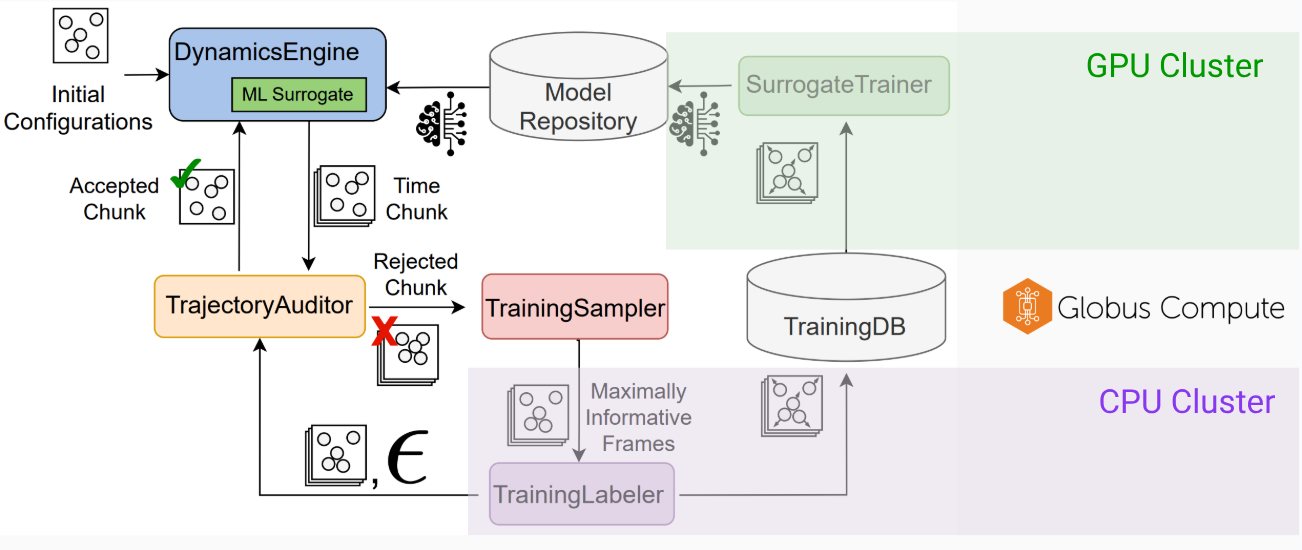
Machine learning (ML) surrogates can accelerate scientific simulations by orders of magnitude by replacing expensive numerical subroutines with comparably cost-effective ML model evaluations, but concerns about their reliability remain active among scientists. Of particular concern is the possibility that a simulation will enter a state outside of the ML surrogate’s training domain, leading to innacurate predictions. On-the-fly learning, wherein ML surrogates are continually monitored for accuracy and updated when inaccuracy is suspected, increases the reliability of ML-driven simulations. Recent work from our group, Proxima, uses control-theory to ensure that simulation error meets a user-defined bound. Cascade extends Proxima to a distributed setting to take full advantage of HPC resources.
Implementations of Proxima and cascade can be found here https://github.com/globus-labs/cascade
Further reading on proxima
- Yuliana Zamora, Logan Ward, Ganesh Sivaraman, Ian Foster, Henry Hoffmann. ICS ‘21: Proceedings of the 35th ACM International Conference on Supercomputing https://doi.org/10.1145/3447818.34603
- Michael Tynes, Logan Ward, Kyle Chard, Ian Foster. Will It Blend? Mixing Numerical and Machine-Learned Physics Quantities for Accurate on-the-Fly Surrogate Modeling. ICCS 2025: 25th International Conference on Computational Science. https://doi.org/10.1007/978-3-031-97632-2_19